Golgonooza
Here on the banks of the Thames, Los builded GolgonoozaWilliam Blake · Jerusalem
Nothing we have made was made alone. Nothing our machines make will be. The work is not to close the loop. It is to keep building, with.
Transcript
In 1965, the statistician Irving John Good imagined a machine that could design a better machine. He wrote: the first ultraintelligent machine is the last invention that man need ever make, provided that the machine is docile enough to tell us how to keep it under control. The picture has lasted. A mind that improves itself, by itself, in a closed loop. This lesson asks one question of that picture. What is the loop made of?
Two Chilean biologists, Maturana and Varela, gave us the word for a thing that makes itself: autopoiesis. A living cell, they said, is a network of processes whose parts go on rebuilding the network that built them. It is a real and beautiful idea. A cell does make its own skin. They added something that is often left out. A cell and its surroundings go on nudging each other for as long as it lives.
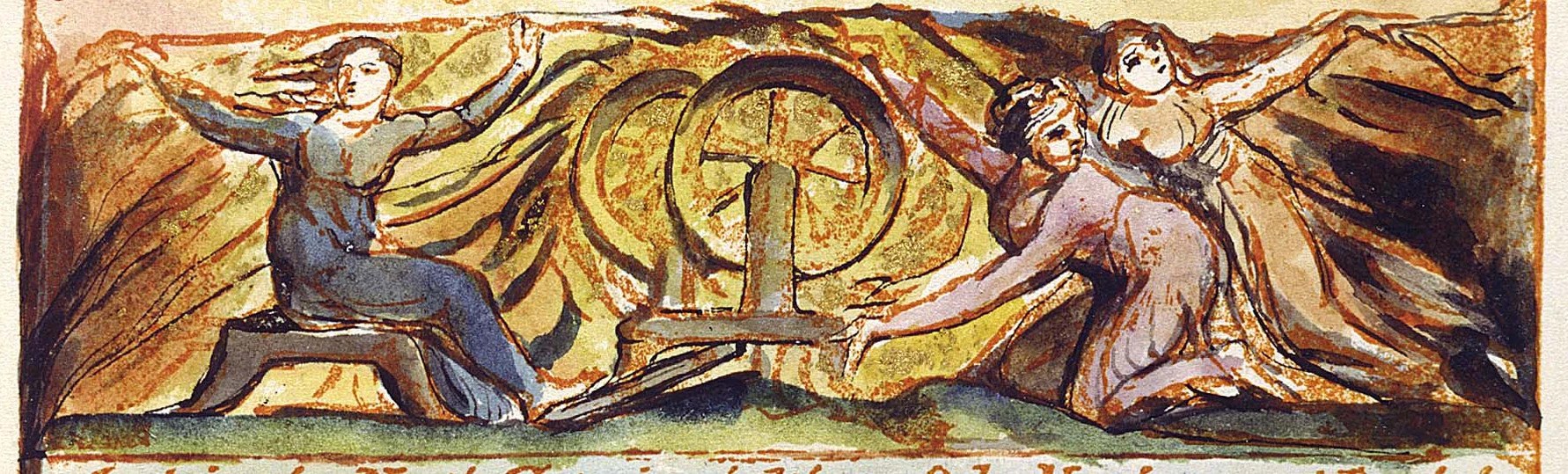
Blake drew the dream of doing without the surroundings. He called him Urizen: self-closed, all-repelling.
Draw each part as a dot. Draw an arrow from one dot to another when the first is needed to make, or mend, the second. Now draw a line round the thing you are calling the system. Here are three shapes such a picture can take. A sealed ring. Every part is made by another part, and nothing crosses the line. This is the dream. A ring with makers outside it. The parts rebuild one another, and arrows still come in across the line. A mesh, with no line at all. Wherever you draw the boundary, arrows cross it.
So here is a test that anyone can run. Colour gold what the system remakes for itself, and blue what comes from outside. Then count. A cell remakes four things: its membrane, its enzymes, its ribosomes, and copies of its genes. Three come from outside: its food, its energy, and the cell it came from. Four of seven. A beehive remakes its workers, its queen, its comb and its stores. Flowers, water, weather, a hollow to live in, and mates from other hives come from outside. Four of nine. Look at the flowers, though. The bees need them, and they need the bees. That arrow runs both ways across the line. Under the leaf litter, a fungus does it on a smaller scale. Thread by thread it grows, branches, and fuses with itself into a net. It remakes its own threads, tips and junctions. The dead wood, the water, the soil, and the colony it came from, it does not. Three of seven. A language has no line to draw. Nobody makes their own words. Each of us got them from others, and most of those others are dead.
Check the count by taking things away. Take the wax from a hive, and the bees make more. Take the flowers away, and nothing inside the hive can put them back. The foragers come home empty, and the colony shrinks to match. Now the same count for a machine that learns. Its weights, it remakes: that is what training is. Its training text, its goals, its tests, its chips, its power, the people who correct it, and the questions it is asked, all come from outside. One of eight. Grant it everything it might do for itself: write its own practice text, mark its own tests. Three of eight. Grant it more. Let it ask its own questions and mend its own code. Something still stands outside the line: what it is for, and who decides whether better is better. Draw the line wide enough to take those in, and it goes round all of us.
In 1998 a Canadian student, Beth Dempster, proposed a second word: sympoiesis. Systems that produce collectively, and do not have self-defined spatial or temporal boundaries. Donna Haraway put it plainly. Sympoiesis is a simple word; it means making-with. Nothing makes itself, she wrote; nothing is really autopoietic or self-organizing. The smith in the last lesson already knew. The iron answered every blow.
Why does this matter for the machines we are building? If a mind makes itself, then it is a fact of nature, like a comet. All we can do is discover what it turns out to be, and hope. If it is made with us, then at every arrow that crosses the line there is somebody: choosing the text, setting the goal, writing the test, asking the question. On that picture, keeping such a system good is not a lock fitted once to a sealed box. It is the work at those arrows, and it does not end. That is an argument, not a proof. You can do the count again yourself.
There is one more thing that every picture of a closed loop leaves out: the person drawing it. Haraway called this the god trick of seeing everything from nowhere. Pull the camera back. The hand is in the picture. So are the others at the table.
London has been drawn in many ways. This is Visscher’s, from 1616: seen from the sky, with angels holding up the name. Every roof, and nobody in it. Blake’s London is walked. I wander through each chartered street, he wrote, and mark in every face I meet marks of weakness, marks of woe. Chartered is the straight line: mapped, measured, owned. Wander is the path a person actually takes. The straight way is shorter. Everything he met was on the extra distance. He hears mind-forged manacles. The closed loop is something a mind forges. You can map a city from above. You can only know it by walking.
Against that London, Blake set a city of his own. Here on the banks of the Thames, Los builded Golgonooza. It is never finished: ever building, ever falling. We like to think of it as built by the living and the dead together, and by those not yet born, who will find it standing and take it for the world.
Winnicott saw the same thing in a baby with a blanket. The baby creates the object, he wrote, but the object was there waiting to be created. Created and discovered, both at once. We agree, he said, never to ask the baby which. Nothing we have made was made alone. Nothing our machines make will be. The work is not to close the loop. It is to keep building, with.
Golgonooza is one of the films made for Albion Rose, a platform for teaching and learning frontier science.
 Go on to Albion Rose